Yap Shu Won
ARCHITECTURAL DESIGN STUDIO 4
In Semester IV themed “engaging environment and community”, the studio explores design by harnessing environmental qualities through projects with a specific community of users within a given context. The projects involve studies of precedents that showcase responses to environmental conditions and sustainable issues as well as innovative interpretations of the given program. Considerations should be given to the complexity of the program, site topography and vegetation, socio-cultural events, and variety of passive strategies for sustainable design. The design work should contribute to and merge harmoniously with environment and the site, and provide meaningful architectural experience for the community of users. The students are to explore architectural intervention that is sensitive to context and the needs of the community mentioned.
PROJECT 1: Children Learning Capsule
Initiating the exploration of ‘Community and Architecture’ Project 1 deals with the basic action of learning through play via the understanding of repurposed materials and their relationship to the crafting of spaces as setting for children’s experience. We are required to design a Children Learning Capsule which is intended to explore the endless possibilities of using abandoned steel shipping containers which have outlived their usefulness as cargo carriers. We are also given the freedom to create symbiotic composition with other recyclable materials of choice as well. It is to develop awareness of environmental sustainability through the responsible and innovative use of reclaimable and repurposed materials in relation to user needs. The capsule must be able to accommodate/support a set of proposed activities designed to instil among children not only a sense of learning through play but also the appreciation of sustainability through the application of reusable materials.
My group chose shipping containers, rope, metal Barrels, sand, and elastic bands as our materials.
 |  |  |
|---|
REFLECTION
In this project, I have learned how to use safe, simple-to-use, and reasonably weather- proof secondary repurposed/reclaimable materials to build a children learning capsule and able to demonstrate its ability to function in a real world situation.
PROJECT 2 : COMMUNITY SUPPORT CENTRE FOR SINGLE-PARENT FAMILIES
Project 2A : Site Analysis
In this project, we are required to design a community support centre for single-parent families. Our given site is located adjacent to the Taman D.R Seenivasagam in Ipoh, a large urban park dating from the early 1950’s. Based on each own tutorial group, we are to first analyse our site. Before we start to design, we have a site visit to this park and analyse the site accordingly. We look into the park's history, circulation, climate, vegetation, demography, views and vistas in order to come out with design considerations on which programme is suitable for the community support centre.
 |  |
|---|
Project 2B
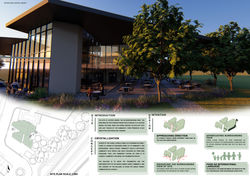
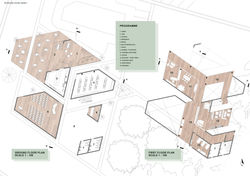
In most of the case, single-parent family is a fragmented family. My hope is to connected these fragmented pieces into whole. I observed the activities done by the single-parent family and decided to implement these activities into my design. As most of the single-parent family has children to raise, my intention is to build a community centre where parent can work while children can carry out activities in this building.
FINAL PRESENTATION BOARD
 |  |  |
|---|---|---|
 |  |  |
 |  Exterior of community centre |  Entrance |
 Lobby and cafeteria |  Inside-out cafeteria where single-parent can work here |  Inside-out cafeteria where single-parent can work here |
 Staircase to first floor |  A real-life gallery walkway to observe activities carried out |  Counselling office |
 Balcony where children can hang out when their parent working |
REFLECTION
Through this project 2, I had learneed how to design and create architectural spaces with consideration of environmental poetics in relation to the basic natural context and existing built context which impact on users’ experiences. Not only that, I learned how to combine the environmental needs, the site , and the users’ experiences within simple building design in the given context.